


Making maps of the world with your homeschool children is an interesting and entertaining way for them to study geography. This hands-on practice both stimulates their creativity and improves their spatial reasoning. They’ll have a greater understanding of the world’s layout as they sketch and label continents, countries, and oceans.
This practice also fosters a greater appreciation for variety, instills a feeling of global citizenship, and provides a foundation for comprehending global challenges. So, why not spice up your homeschooling curriculum with our selection of geography books that will inspire and guide your children to design maps of the world?
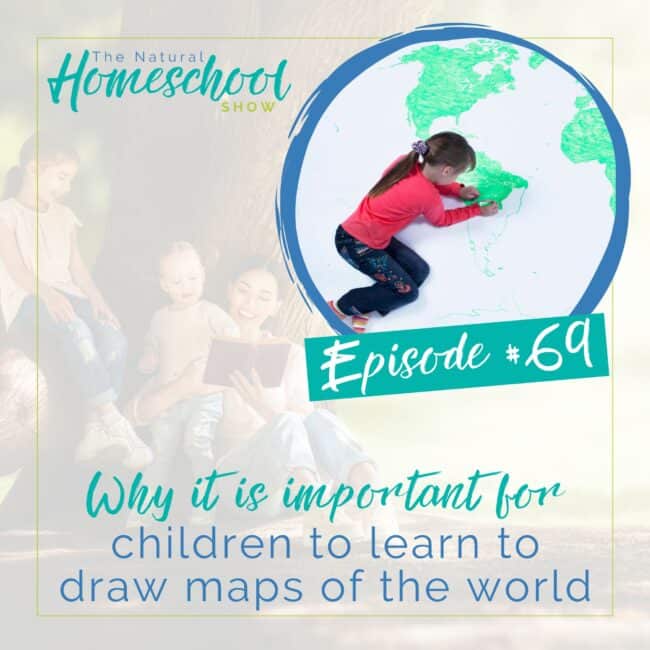
Here is the training in its entirety. You will read all of the important points, watch the video training and get the list of resources.
Episode 69: Why it is important for children to learn to draw maps of the world
Getting your homeschool children to draw maps of the world is an engaging and fun way to learn geography.
Draw Maps of the World
Children may easily identify the locations of continents and countries on a globe by drawing maps, which is an efficient teaching technique. Drawing allows students to interact with the spatial relationships between various geographic locations, which in turn helps them grasp where continents and countries are in relation to one another. They will become more accustomed to where these geographical features are located, which will make it simpler for them to locate them in the future on a map or globe.
Children need to draw maps of the world to help them recall the forms of the continents and nations. Children actively process the distinctive contours and features that distinguish each continent and nation as they actively participate in the sketching exercise.
Drawing maps is a great memory aid for kids. It not only helps them remember where things are geographically. It also allows them to recall different features within continents and nations. Children can add key landmarks like mountains, rivers, towns, and historical locations as they draw the contours of continents and nations.
Learn Geography the easy way
The information presented above is very thorough. It’ll help homeschooling parents comprehend the significance of teaching their kids how to make maps. Kids may actively learn geography and create a customized mental map of the world. They can always count on using maps as an exciting teaching tool.
#thenaturalhomeschool #thenaturalhomeschoolshow #homeschoolideas #homeschoolactivities #thenaturalhomeschoolpodcast #homeschoolstyle #naturalhomeschooling #homeschoolingideas #homeschoolcurriculum #curriculumforhomeschool #homeschoolstyle #homeschoolmethods #homeschooltopics #homeschoolprojects #homeschoolteaching #homeschoolingstyle
Wardrobe from: http://bit.ly/TNHstitchfix
Here are past episodes that you might like.
Watch ALL episodes HERE.
Episode 43: Montessori Science: Focusing on Life Cycles
In this training, we will be focusing on how to go about using life cycle activities for Montessori Science, whether it is Botany or Zoology.
Montessori Science Life Cycles [Live Training]
Science can be such a great hands-on subject, especially if The Montessori Philosophy is used. In the Montessori Science curriculum 3-6, children learn best in a specific order. They start with Botany, but Zoology follows closely. In studying life cycles, you can involve both branches of Science (Zoology and Botany). Both are connected to life…
Episode 42: Supplements with Essential Oils for Immunity

Did you know that you don’t have to take supplements in the form of a pill? Come find out about these fantastic supplements with essential oils for immunity (Young Living)!
Episode 41: Chores for Children the Montessori Way
Do you have family chores at home? What about individual ones for each child to do? Do you have several family members that have daily responsibilities in your home? Whether you have older kids or younger ones, we will be discussing what you can do to…
Episode 40: Home Learning Tips for Older Students
In this training, we are going to focus on home learning tips for older students (upper elementary and middle school).
Leave a Reply