


Making maps of the world with your homeschool children is an interesting and entertaining way for them to study geography. This hands-on practice both stimulates their creativity and improves their spatial reasoning. They’ll have a greater understanding of the world’s layout as they sketch and label continents, countries, and oceans.
This practice also fosters a greater appreciation for variety, instills a feeling of global citizenship, and provides a foundation for comprehending global challenges. So, why not spice up your homeschooling curriculum with our selection of geography books that will inspire and guide your children to design maps of the world?
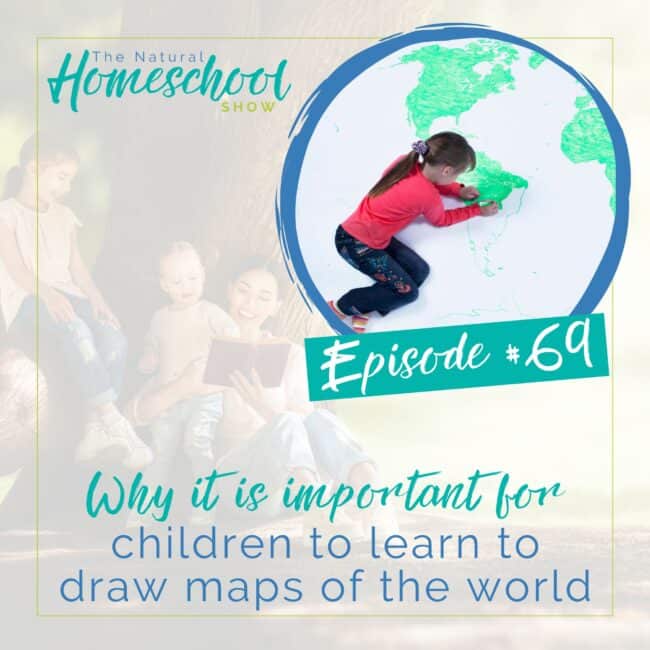
Here is the training in its entirety. You will read all of the important points, watch the video training and get the list of resources.
Episode 69: Why it is important for children to learn to draw maps of the world
Getting your homeschool children to draw maps of the world is an engaging and fun way to learn geography.
Draw Maps of the World
Children may easily identify the locations of continents and countries on a globe by drawing maps, which is an efficient teaching technique. Drawing allows students to interact with the spatial relationships between various geographic locations, which in turn helps them grasp where continents and countries are in relation to one another. They will become more accustomed to where these geographical features are located, which will make it simpler for them to locate them in the future on a map or globe.
Children need to draw maps of the world to help them recall the forms of the continents and nations. Children actively process the distinctive contours and features that distinguish each continent and nation as they actively participate in the sketching exercise.
Drawing maps is a great memory aid for kids. It not only helps them remember where things are geographically. It also allows them to recall different features within continents and nations. Children can add key landmarks like mountains, rivers, towns, and historical locations as they draw the contours of continents and nations.
Learn Geography the easy way
The information presented above is very thorough. It’ll help homeschooling parents comprehend the significance of teaching their kids how to make maps. Kids may actively learn geography and create a customized mental map of the world. They can always count on using maps as an exciting teaching tool.
#thenaturalhomeschool #thenaturalhomeschoolshow #homeschoolideas #homeschoolactivities #thenaturalhomeschoolpodcast #homeschoolstyle #naturalhomeschooling #homeschoolingideas #homeschoolcurriculum #curriculumforhomeschool #homeschoolstyle #homeschoolmethods #homeschooltopics #homeschoolprojects #homeschoolteaching #homeschoolingstyle
Wardrobe from: http://bit.ly/TNHstitchfix
Here are past episodes that you might like.
Watch ALL episodes HERE.
3 Ways to do Discipline the Montessori Way
Montessori discipline is a very touchy subject. Many people avoid it because discipline itself is kind of a taboo topic. But it is VERY important to talk about it. And it is even more important to discuss discipline the Montessori way Why? Because it is going to be something you want to implement if you…
Episode 29: Discipline the Montessori way
In this training, I will give you three very important categories in discipline to pay attention to in order to do discipline the Montessori way.
How to judge where you are in your Montessori journey
This is going to be a very complete and such a great training for you! Be sure to watch or listen to the live training and read through the points that I talk about here. You will be glad you did because this is an essential step in your transformation! If you are looking to…
Episode 28: How to judge where you are in your Montessori journey
Are you wondering where you are in your Montessori journey and how to know where you go from here?
An Introduction to Montessori Normalization in Children
The phrases “Montessori Normalization” or “Normalized Children” are not, in any way, judgmental. They convey a misconception because of the language used. Basically, Maria Montessori was Italian and her works were in that language. I know that “normalization” comes from the word “normal,” but it doesn’t mean at all that we are talking about whether…
Leave a Reply