


Running an ABA therapy practice without the right software is like trying to bill Medicaid by hand while also tracking 30 behavior programs across 10 clients. ABA practice management platforms exist to prevent that kind of chaos, and yet picking the wrong one still trips up plenty of clinic owners.
Billing claim denials, HIPAA-compliant data storage, and coordinating schedules across BCBAs and RBTs are all real daily pressures. After reviewing dozens of platforms across clinical documentation, billing, and scheduling capabilities, this guide breaks down the five strongest options available right now.

The shortlist methodology
Public sources guided every evaluation here: user reviews, feature breakdowns from official websites, case study outcomes, and ratings pulled from software directories. Only platforms with a documented track record in healthcare software made the cut. Criteria stayed focused on real-world clinical and operational fit, not marketing claims.
→ See the full research breakdown
- Theralytics – Best for clinical work and compliance-focused practices
- Passage Health – Best for ABA therapy practice management and autism care providers
- CentralReach – Best for autism and IDD care providers, ABA therapy practices, and special education institutions
- ABA Matrix – Best for ABA therapy practices and behavioral health clinics
- Ensora Health – Best for mental health and rehabilitation therapy practices
Why the Right ABA Practice Management Platforms Make a Difference
Picking the wrong platform doesn’t just cause frustration. It costs money, burns staff time, and puts HIPAA and payer compliance at real risk.
When a practice runs billing separately from clinical documentation, claim denials climb fast. Payers reject sessions that lack complete, properly formatted notes. Authorization renewals slip through the cracks. RBT scheduling conflicts go unnoticed until a client misses a session.
Specialized ABA practice management platforms close these gaps by connecting clinical data directly to billing workflows. That connection matters for clean claims rate and first-pass billing approval, which directly shapes average revenue per authorized session.
The right platform also keeps session documentation complete and on time, which supports both payer audits and outcome reporting. That kind of operational discipline is hard to build without software that was actually designed for how ABA practices work.
Top 5 ABA Practice Management Platforms: Specs at a Glance
Note: All data in this table is sourced from review platforms and the official websites of the listed companies.
| Company Name | Years Operating | Team Size | Headquartered In |
| Theralytics | Est. 2017 | 11 – 50 | St. Petersburg, FL |
| Passage Health | Est. 2022 | 27 | New York, NY |
| CentralReach | Est. 2012 | 357 | Fort Lauderdale, FL |
| ABA Matrix | Est. 2017 | 11-50 | Miami, Florida |
| Ensora Health | Est. 2013 | 600 | Birmingham, AL |
1 Theralytics – Best for Clinical Work and Compliance-Focused Practices
What Makes Theralytics Stand Out?
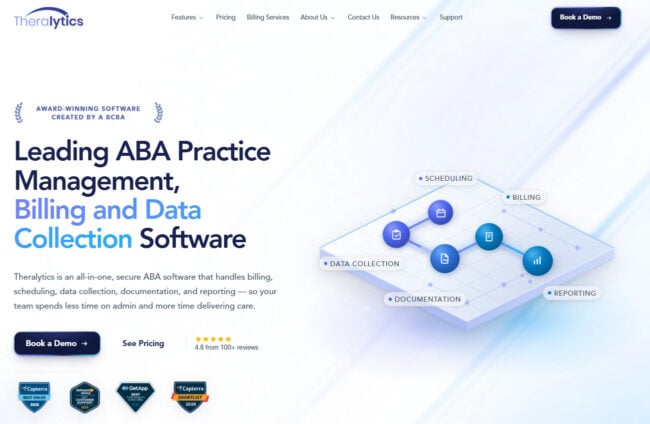
Theralytics, ABA billing software, brings clinical documentation and practice operations into a single, synchronized platform. BCBAs, supervisors, and clinicians all work from the same real-time data, which cuts the back-and-forth that normally slows session documentation and billing.
The platform automates progress graphing, provides a parent and caregiver portal, and handles scheduling and billing tied directly to session-level data. Practices that rely on Theralytics for their operations benefit from SOC 2 Type II certification, mandatory multi-factor authentication, and AES-256 encryption, all of which satisfy HHS technical safeguard requirements without adding IT overhead.
What Makes Theralytics Stand Out for ABA Practice Management Platforms?
Disconnected clinical and billing systems are one of the most common reasons ABA practices see elevated claim denial rates, and Theralytics directly addresses that by keeping session data and billing logic in the same environment. That architecture means documentation errors that would normally trigger denials get caught before claims go out, which protects both revenue and audit readiness.
The Verdict from Users:
Users consistently point to the platform’s intuitive design and the way it removes the friction of manual data entry across multiple systems. The flexible pricing model comes up often, especially from smaller practices that need enterprise-grade security without enterprise-grade costs. That combination of compliance depth and accessible pricing is genuinely rare at this level.
2 Passage Health – Best for ABA Therapy Practice Management and Autism Care Providers
What Makes Passage Health Stand Out?
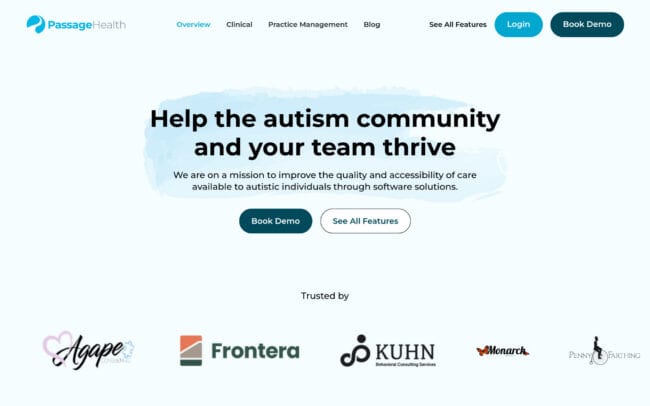
Passage Health focuses exclusively on ABA and autism care, which shapes every feature decision the team makes. The platform covers data collection, treatment plan building, supervision tools, and real-time progress monitoring.
The development process stands out: the product was built alongside 100+ practices and clinical advisors, so the features reflect actual workflow needs rather than guesses. Offline capability is a practical standout (useful for center-based and home-based sessions with spotty connectivity), and the real-time syncing keeps supervisors and RBTs on the same page without manual check-ins.
What Makes Passage Health Stand Out for ABA Practice Management Platforms?
Many ABA platforms try to serve multiple therapy disciplines, but Passage Health’s single-specialty focus on autism care means the clinical tools go deeper where ABA workflows actually need them. The $10.2M in secured funding from reputable investors backs continued product development, which matters for practices thinking about where their software vendor will be two years from now.
The Verdict from Users:
Users flag the setup experience as smoother than expected, with dedicated support reducing the typical learning curve that comes with switching platforms. The analytics and insights features get consistent praise for making progress monitoring less time-consuming. Reliability of offline functionality earns particular appreciation from home-based providers.
3 CentralReach – Best for Autism and IDD Care Providers, ABA Therapy Practices, and Special Education Institutions
What Makes CentralReach Stand Out?
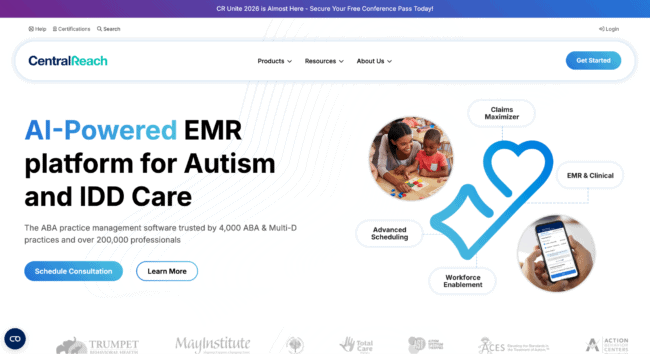
CentralReach serves over 4,000 ABA practices and 200,000+ professionals, which puts it in a category of its own for scale and market presence. The platform covers practice management, clinical data collection, scheduling, billing, and care team management in one place. The standout is their proprietary AI called cari, trained on over a billion data points developed with more than 40 BCBAs.
That’s not a generic AI layer bolted on top; it was built for autism and IDD care contexts. The company’s acquisition by Roper Technologies in early 2025 signals continued investment and long-term stability (think enterprise backing with a specialized platform underneath).
What Makes CentralReach Stand Out for ABA Practice Management Platforms?
CentralReach solves the problem of clinical and operational fragmentation at scale, giving large multi-site practices a single system that holds together across clinical data, billing, and team management without requiring third-party workarounds. That kind of end-to-end depth is hard to match at the volume they operate.
The Verdict from Users:
CentralReach has earned 40+ industry awards, including Deloitte Technology Fast 500 recognition and Stevie Awards for product innovation. Reviewers point to the breadth of features as a major strength, though some smaller practices note the platform’s depth can require more setup time. For a large or growing multi-site operation, that tradeoff tends to be worth it.
4 ABA Matrix – Best for ABA Therapy Practices and Behavioral Health Clinics
What Makes ABA Matrix Stand Out?
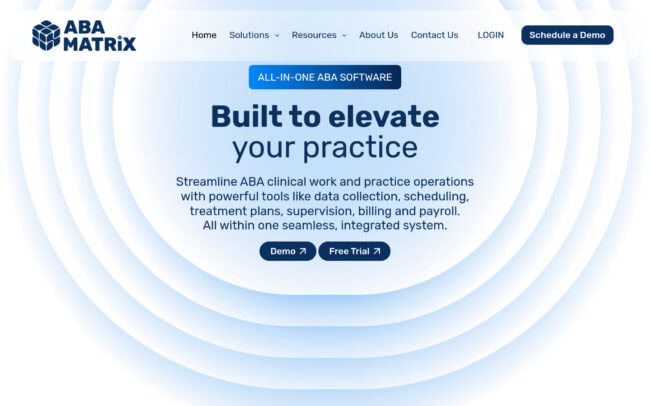
ABA Matrix covers the full operational picture for behavioral therapy practices: data collection, scheduling, billing, progress notes, data assessments, graphing, reporting, compliance alerts, and payroll management. The platform is HIPAA-compliant and developed in line with CASP Guidelines, which matters for practices that need to show payers and accreditation bodies that their clinical processes meet recognized standards.
What’s interesting here is the business model. ABA Matrix operates as a bootstrapped, independent company with a per-unit pricing structure, which tends to benefit smaller practices that don’t want to pay for seats they’re not using.
What Makes ABA Matrix Stand Out for ABA Practice Management Platforms?
The per-unit pricing model solves a real frustration for solo practitioners and small clinics who consistently overpay on per-seat subscriptions when staff utilization rates fluctuate. Paired with CASP Guidelines compliance, ABA Matrix makes a strong case for practices that need both cost control and clinical credibility.
The Verdict from Users:
ABA Matrix received the Top ABA Therapy Data Collection and Practice Management Platform 2026 designation from Healthcare Tech Outlook Magazine, and case study data points to measurable gains in clinical outcomes and operational performance. Users value the compliance-focused design and the straightforward pricing, particularly practices that have previously struggled to control software costs as their caseloads grow.
5 Ensora Health – Best for Mental Health and Rehabilitation Therapy Practices
What Makes Ensora Health Stand Out?
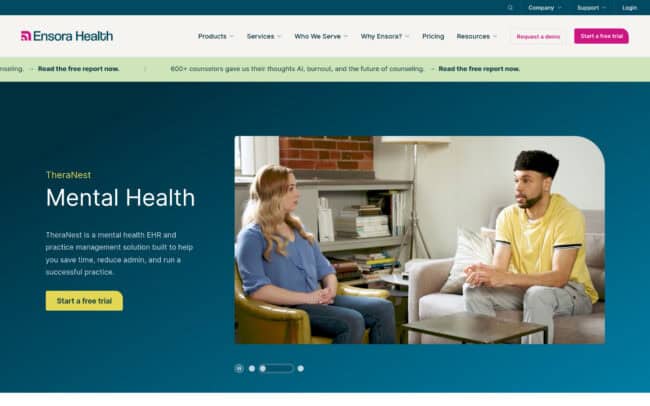
Ensora Health runs two platforms: TheraNest for mental health providers and Fusion for rehabilitation therapy. Together, they serve more than 200,000 individual providers across 28,000+ practices. The software suite covers EHR, practice management, e-prescribing, billing, and revenue cycle management.
Pricing starts at $29 per month (genuinely accessible for solo practitioners), and the company has plans to deploy AI tools across both platforms. G2 recognized Ensora as a Leader in mental health software, and Fusion ranked in G2’s Top 50 Healthcare Software list for rehabilitation therapy.
What Makes Ensora Health Stand Out for ABA Practice Management Platforms?
Ensora Health tackles administrative overload across multiple therapy disciplines by offering software that connects clinical documentation directly to billing and revenue cycle management. For practices that operate across specialties, or are adding ABA services alongside mental health or rehab programs, that cross-discipline coverage reduces the need for separate tools.
The Verdict from Users:
Users consistently mention the accessible entry pricing and the reduced administrative workload as the two biggest wins. The dual-platform approach gets positive marks from multi-specialty practices that previously managed disconnected systems. Compared to heavier enterprise platforms, Ensora Health’s design feels more approachable for smaller teams without sacrificing the clinical and billing features they actually need.
The Research Behind These Recommendations
Establishing Your Information Foundation
The research started by pulling together a broad list of platforms operating in the ABA practice management and behavioral health software space. Sources included specialty software directories, healthcare technology review platforms, clinical association resources, and individual practice case studies shared publicly by vendors. The goal at this stage was breadth: capturing as many active platforms as possible before filtering began. No option was excluded at this point based on size, pricing, or reputation alone.
Reducing to Your Top Contenders
Once the initial list was assembled, platforms without verifiable presence in the ABA-specific space were removed. That meant checking whether each option had documented use among BCBAs, RBTs, or ABA clinic administrators, not just general therapy providers.
Review patterns across multiple platforms were analyzed to identify consistency: a company with strong ratings on one site but minimal reviews elsewhere received less weight than one with consistent feedback across several independent sources. Platforms with unresolved complaints or gaps in documented feature delivery were also removed at this stage.
Checking Facts Against Available Evidence
Each remaining platform’s website claims were cross-checked against what actual users reported in reviews and case studies. When a vendor stated that their billing tools reduced claim denials or that their scheduling features supported multi-site coordination, those claims were evaluated against documented user experiences.
Where claims appeared unsupported or overstated relative to review sentiment, that factored into the final assessment. Platforms with a tight alignment between what they claimed and what users confirmed were rated more favorably.
Where Each Pick Stands in the Industry
Industry signals were reviewed for each shortlisted platform. That included award recognition from healthcare technology organizations, mentions in clinical or health technology publications, and any original research or outcome data published by the companies.
Recognition from credible bodies, consistent placement on industry lists, and documented clinical outcome data all added weight to a platform’s inclusion. Newer platforms without extensive award history were evaluated on the strength of their funding, advisor networks, and documented user base growth instead.
ABA Practice Management Platforms-Specific Validation
The final validation step looked at how each platform addresses the real operational demands of ABA practices. That meant checking for dedicated features around ABA data collection, HIPAA and payer compliance documentation, Medicaid billing support, and authorization management tools.
Platforms with dedicated service pages, verified reviews from ABA-specific users (BCBAs, clinic owners, RBTs), and case studies showing measurable improvements in session documentation or billing outcomes carried the most weight in the final selection.
User’s Guide: Choosing the Right ABA Practice Management Platforms
Choosing an ABA practice management platform is a long-term operational decision, not just a software purchase. The right fit depends on where your practice is today and where it’s headed. Here are the five areas worth evaluating carefully before committing.
- Industry and Domain Experience: Look for platforms built for ABA therapy, not general healthcare software adapted for it. Purpose-built tools understand the clinical workflows, billing codes, and documentation standards that generic platforms often miss.
- Features and Services: Confirm the platform covers your actual workflow: data collection, session notes, scheduling, billing, and authorization management. A long feature list means nothing if the features your team uses daily are clunky or disconnected.
- Pricing Structure: Per-seat, per-client, and per-unit models all affect cost differently as you grow. Match the pricing model to your expected caseload growth and staff utilization patterns.
- Results Measurement: Platforms that surface clean claims rates, session documentation completion rates, and authorization turnaround times give you the data to actually manage performance, not just hope things are running smoothly.
- Industry Knowledge and Compliance: Verify that any platform you consider meets HIPAA, Medicaid billing rules, and state ABA licensure requirements. Ask for specific documentation, not just a checkbox on their pricing page.
What This Means for You
The right ABA practice management platform changes what’s actually manageable at the practice level. Billing accuracy, session documentation, scheduling coordination, and compliance all depend on tools that were designed for how ABA clinics actually operate.
The platforms covered here each bring something specific to the table, whether that’s enterprise security, single-specialty depth, scheduling powered by advanced tools, or accessible pricing for smaller teams. As practice sizes and payer requirements keep shifting, the gap between purpose-built and generic software will only grow wider.




You might also like:
-
Sale!

Reusable Printable Homeschool Mini Planner (36 pages)
$18.00$9.99 Add to cart

Latest Posts
- Simple Music Paper Crafts for Preschoolers (Free Printable)
 Do you teach Music in your homeschool? Have you ever thought of making Music-related crafts that are fun and affordable? Making Music-related crafts can spark so much creativity and go for several Fine Arts areas all at once! Take a look at what we’ve made! Stars, pinwheels, tambourines, flowers… we’ve…
 - Best ABA Practice Management Platforms for Small and Growing Practices
 Running an ABA therapy practice without the right software is like trying to bill Medicaid by hand while also tracking 30 behavior programs across 10 clients. ABA practice management platforms exist to prevent that kind of chaos, and yet picking the wrong one still trips up plenty of clinic owners.…
 - Fun and Easy Colonial Recipes for Kids
 Introducing your kids to colonial recipes is a hands-on way to learn about life during the American Revolutionary War while whipping up delicious and simple treats.
 - 5 Leading Psychiatrists in Los Angeles for OCD in Adults
 OCD is one of the most misunderstood and undertreated mental health conditions in the country, and Los Angeles makes that problem worse. Leading psychiatrists in Los Angeles are genuinely hard to find because the city has a serious shortage of mental health providers, insurance coverage for psychiatric care is inconsistent…
 - History about Past and Present the Montessori Way {Free Printables}
 In this post, you will see how we made a connection between the past and the present. I made matching cards on objects, one used in the past and one used in the present. This post is focusing on history about past and present in the best way possible:…




Leave a Reply